

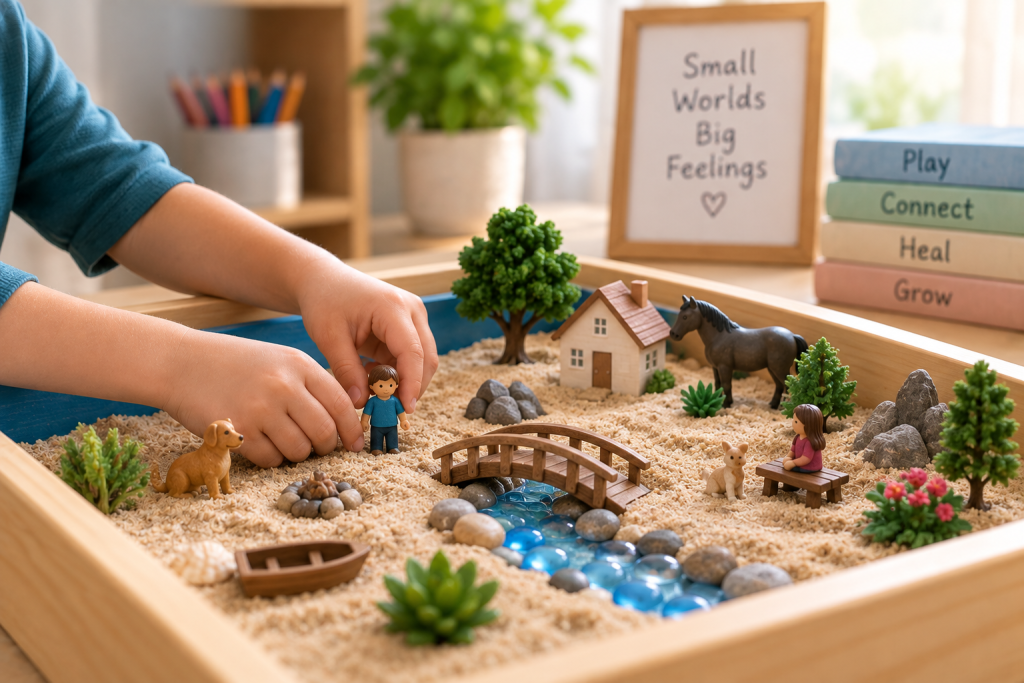
Many of us remember playing in a sandbox or at the beach as children. We may have built castles, towns, roads, or entire imaginary worlds using sand and our creativity. For children, this type of play is more than entertainment. Play can be a powerful way to explore emotions, process experiences, and make sense of the world.
In therapy, sand can become a therapeutic tool through an intervention called sandtray therapy. Sandtray provides children—and individuals of all ages—with a creative, hands-on way to communicate thoughts and feelings that may be difficult to express through words alone.
Is Sandtray Really Therapy?
Yes! Sandtray has been used as a therapeutic intervention for more than a century. It was developed in the 1920s by Margaret Lowenfeld, a pediatrician who was interested in helping children communicate their inner experiences.
Through her work, Lowenfeld observed that children naturally created miniature worlds using sand and small figures. These creations often provided children with a way to communicate experiences and feelings that were difficult to express verbally.
Today, sandtray is frequently used within play therapy and other therapeutic approaches. Although it is particularly helpful for children, sandtray can be adapted for adolescents and adults as well.
Children are still developing their ability to identify, understand, and communicate complex emotions. This is why play therapists often describe play as the language of children. Through play, children can process experiences, experiment with different possibilities, and communicate feelings in a way that feels natural to them.
What Is Sandtray Therapy?
Sandtray typically involves a small container filled with sand and a collection of miniature figures. Depending on the therapist and the individual’s needs, water and other creative materials may also be incorporated.
The miniatures can represent virtually anything, including people, animals, buildings, nature, vehicles, emotions, relationships, and everyday objects. Therapists carefully select a variety of figures so clients have many options for expressing themselves.
A therapist may invite a child to create a scene related to a particular concern or therapeutic goal. For example, they might ask:
- “Create your world.”
• “Show me what school feels like.”
• “Create a scene about something that is difficult for you.”
• “Build a picture of your family.”
Other times, the child may simply be given the opportunity to create whatever comes to mind.
As the child builds the tray, the therapist often observes and provides space for the child to direct the process. After the tray is completed, the therapist may ask open-ended questions about what was created.
Importantly, therapists should not assume that a particular figure or object has a universal meaning. The client is the expert on what their creation represents. A therapist may ask, “Tell me about this figure,” rather than deciding what the figure means for the child.
How Does Sandtray Help?
It Makes Feelings More Concrete
Emotions and experiences can be difficult to explain, particularly for children. Sandtray allows abstract thoughts and feelings to become something physical that can be seen, touched, moved, and discussed.
A child who struggles to explain feeling overwhelmed at school, for example, may be able to demonstrate that feeling through the arrangement of figures in the sand. Seeing the experience outside of themselves can sometimes make it easier to understand and talk about.
It Provides a Nonverbal Way to Communicate
Have you ever thought, “I know what I’m feeling, but I don’t know how to explain it?”
Children experience this frequently. Sandtray provides another avenue for communication when words are difficult to find.
This can be especially helpful for children who have difficulty identifying emotions, individuals who struggle with verbal expression, or anyone who feels more comfortable communicating creatively.
It Is Hands-On and Multisensory
Sandtray is a tactile experience. Moving sand and arranging miniature figures engages the senses and can be calming and regulating for some individuals.
The process can incorporate visual, tactile, movement-based, and verbal experiences, which can help increase engagement and make therapy feel more accessible and meaningful.
It Can Create Emotional Safety
Discussing difficult topics such as fear, shame, grief, trauma, or family conflict can feel overwhelming. Sandtray can provide some emotional distance by allowing a person to communicate through the world they create.
Instead of having to say, “I am scared,” a child might explain that a figure in the tray is scared. This shift can make difficult emotions feel safer to explore.
It Gives Children a Sense of Control
Therapy can sometimes involve discussing situations that children had little control over. Sandtray offers an opportunity to experience control in a healthy way.
The child decides which figures to use, where to place them, and how the scene develops. Because the tray can be changed or recreated, children can experiment with different possibilities and experience a sense of mastery.
Who Can Benefit From Sandtray Therapy?
While sandtray is often associated with children, people of all ages can benefit from this therapeutic approach.
Sandtray may be particularly useful for individuals who:
- Have difficulty expressing emotions verbally
• Have experienced trauma or difficult life experiences
• Feel uncomfortable discussing a particular concern
• Tend to overthink or intellectualize their emotions
• Feel stuck in therapy
• Want to explore relationships or experiences creatively
• Prefer hands-on or experiential activities
For children, sandtray can be particularly effective because it feels less like answering questions and more like creating, exploring, and playing.
The Takeaway
Sandtray is much more than playing in a box of sand. When incorporated by a trained mental health professional, it can provide a meaningful way to explore emotions, relationships, experiences, and challenges.
For children especially, sandtray offers an important message: You don’t always have to have the words to be understood.
Through sand, miniatures, creativity, and imagination, children can begin to communicate their experiences, develop greater self-awareness, process difficult emotions, and discover new ways of understanding themselves and their world.
If you feel like you or somebody you care about is in need of additional support, CFSC is here for you. Please call us at 248-851-5437 to get started with supportive services.

- Sandtray in Therapy: Helping Children Express What Words Can’t - September 23, 2026
- Get Out of Jury Duty When Siblings Fight - September 21, 2016